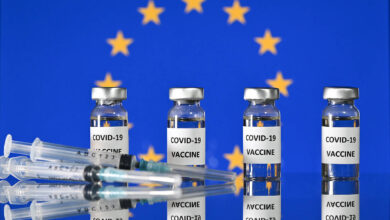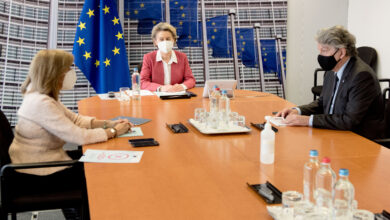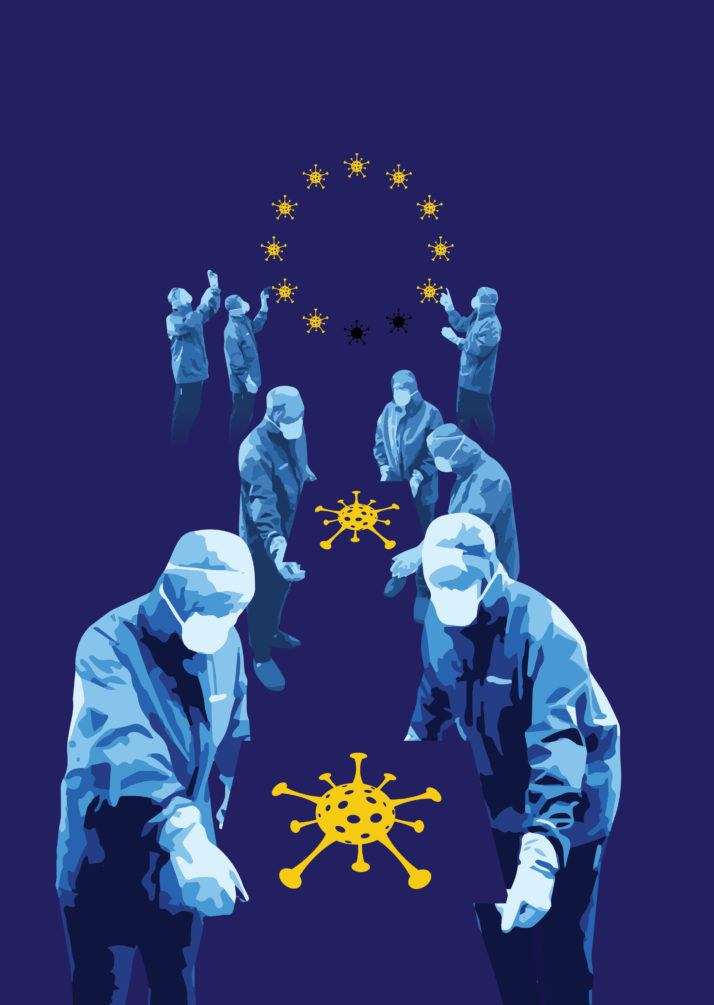
Let’s get straight to the point: the EU is losing the war of hearts and minds in its struggle against COVID-19, the newest strand of the coronavirus family. Despite its suspension of the Stability and Growth Pact, its joint coordination of production and distribution of direly needed medical equipment, the earmarking of billions to struggling SMEs, and the ECB’s Pandemic Emergency Purchase Programme, the Union is being out PR’ed by the Chinese, Cubans, and Russians.
The EU and the Novel Coronavirus Response
The medical personnel and supplies sent by these countries were accompanied by lots of cameras eager to capture the physical manifestations of their respective countries’ benevolence in aiding an ailing Italian healthcare system. Never mind reports of domestic chaos in Russia, the Chinese government’s complicity in aggravating the early stages of this coronavirus pandemic, or the rather negligible impact of the handful of Cuban doctors. The tsunami of pictures and musically-edited videos was enough to sway swathes of the Italian (and European) population of this aforementioned benevolence.
Where was, or rather is, the European Union in all this? No one saw masks and doctors being dispatched under EU flags, followed by Euronews cameras during the course of the coronavirus pandemic for now. That is exactly because healthcare – including pandemic public health interventions is, by treaty, not an exclusive EU competence on subsidiarity grounds. It is allowed to coordinate, aid, and assist in R&D, but it is not the final decision-maker nor implementor of health policy. As such, we have arrived at the crux of a problem which neofunctionalists might dub a ‘spillover’ effect, particularly in addressing a pandemic. In this respect, the subsidiarity test needs to be revisited.


A Lack of Coordinated Efforts?
The reality of our borderless internal market necessitates a coordinated effort in tackling the pandemic and future outbreaks. If anything, the stark contrast between the respective responses of the Dutch and Belgian governments epitomises the necessity of a movement towards more centralised and comprehensive pandemic response capabilities at the EU level: as Belgium went into lockdown, many of its citizens enjoyed the many restaurants and bars its neighbour’s provinces of Zeeland, Brabant, and Limburg had to offer. Moreover, the initial choice for herd immunity in the Netherlands, in a region as compact and integrated as the Benelux, threatened to nullify Belgium’s relatively stringent containment attempts. Were it not for Dutch PM’s Mark Rutte’s pivot to social distancing, Belgium could have been the victim of ‘coronavirus-leakage‘.
That being said, the Belgian-Dutch case exposes a fundamental obstacle to European integration in rapid pandemic response policy: namely the split between virologists who espouse a more Darwinian herd immunity approach; and those who prefer the long-term game of (intermittent) social distancing until a vaccine arrives on the scene. How comfortable are Europeans with these decisions being taken by national bureaucrats, let alone Brussels? Yet surely the case must be made for a science-based European capacity of intervention that escapes the conniving politicking of the Member States.
Policy, Public Health and Further Questions
A more salient problem for the EU is that healthcare is one of the few policy domains that still justifies the continued existence of nation-states in an increasingly globalised world. Does this, however, hold true for pandemic public health interventions including during the current coronavirus one? Taking decisions about how we want to take care of our elderly and sick, defines us, or so the popular interpretation goes. These decisions serve as cultural markers of identity, of continental solidarity.
More importantly, health policies – or rather, how much you’re willing to spend on healthcare – is the alpha and omega of electoral cycles. The political sacrifice that would entail giving up this policy field to Brussels, would simply be too high a cost for our current courageous generation of intergovernmental leadership to give up. Yet, the subsidiarity principle demands us revisiting the status quo.


The EU, then, is caught between its perceived and intergovernmental, treaty-imposed inertia on the one hand, and the inability or rather unwillingness of Member States to endow it with the resources and competences to deal with issues that clearly necessitate a response at the European level. In fact, the Union is left with monetary and (limited) fiscal policy instruments, along with regulatory suspensions, to deal with the economic fall-out of the novel coronavirus, COVID-19. Conversely, it is at the mercy of its Member States sense of solidarity, or lack thereof, when it comes to masks, medical personnel, and ICUs – those now histrionic items that make for great cinema.
A Coronavirus Tragedy or a Tale of Hope?
Churchill once warned against wasting a good crisis. And if anything, this generation-defining emergency is being seized upon by the forces of malignant authoritarianism. It would be a tragedy to see the EU unravel because it appears to find itself in a dilemme cornélien, between its competences and the Member States, when clearly there is an added value to be had by endowing it with the powers and resources to coordinate a pan-European pandemic response.
Provided the European leadership provides the right legal lighting, the cameras will surely follow. It would serve our national(ist) leadership well to remember the leading French revolutionary Georges Danton’s words: il nous faut de l’audace, encore de l’audace, toujours de l’audace.