Today, the Russian Federation is voting to elect its new President for the next six year term. This is the highest office in the country, with the holder being the head of state and the Supreme Commander-in-Chief of the Armed Forces. Two key powers which allow the President a far-reaching political influence are their right to determine the country’s foreign policy stance and their right to nominate candidates for most official state positions, such as for the Constitutional Court, the Supreme Court, and the Federation Council – the upper house of the Parliament.


The results are give Vladimir Putin an unsurprisingly easy victory, with opinion polls giving him around 70% of thepreferences – ten times more than his nearest challenger. However, this resounding victory for a fourth term as President could be dampened by low turnout due to voter fatigue: with the result so obvious from the start, they is little incentive for Russians to turn up to the polling stations. To try and inflate the turnout, Putin’s officials have allegedly been selling discounted goods at polling stations, and instructing state to photograph themselves at the polling booth and report back to their bosses.
Electoral System
Russian Presidential elections take place every six years in a two-round electoral system. During the first round, an absolute majority is required to win. If no candidate gets 50%+1 of the votes, a second round is held exactly three weeks later between the two candidates with the most votes. To this day, in the six elections which have taken place since 1991, a second round was required only once, and it is unlikely that 2018 will be any different.

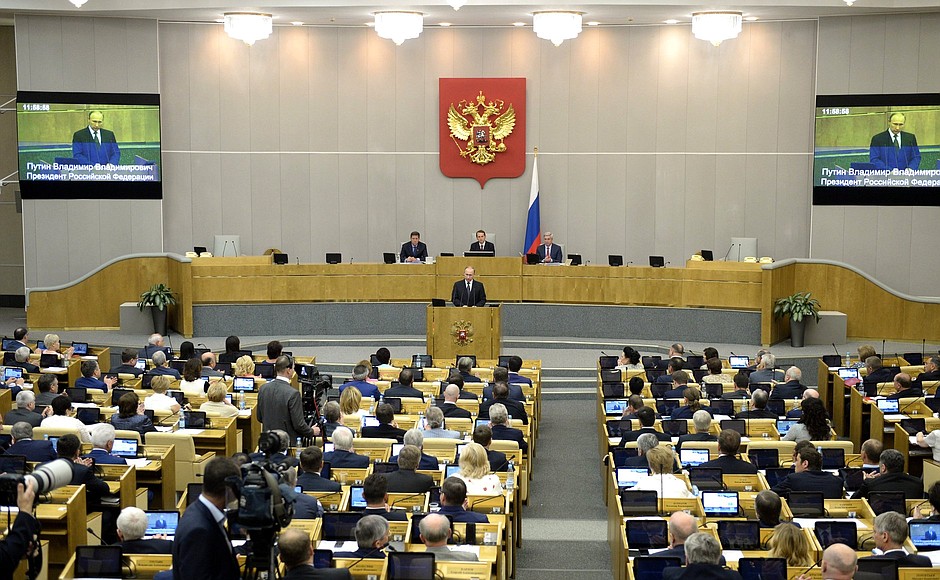
According to the Constitution, any Russian citizen who is more than 35, has permanently resided in Russia for the 10 years leading up to the election, and has committed no serious crime can run for Presidency. However, individuals running as independents or with the backing of a political party which is not represented in the State Duma, the lower house of the Parliament, face an additional obstacle. Those with the backing of a political party have to collect 100.000 signatures in support of their candidacy, while for independents that number goes up to 300.000. Moreover, there is a ban on more than two consecutive terms in office, although Presidents are free to run again for a further third and fourth time after sitting out once full electoral term.
Main Candidates and Positions
There are 7 contenders trying to take the title from Putin, although none of them have the support needed to even be a threat to the incumbent President. Here is an overview of who these eight candidates are and what they stand for:
- Vladimir Putin, already thrice President of the Russian Federation, is the clear frontrunner in the race, with the backing of a number of parties throughout the political spectrum. Although he has not presented an electoral programme, and has refused to partake in TV debates with the other candidates, he is easily going to win on a well-known platform and political approach.
- Pavel Grudinin, an engineer and farmer backed by the Russian Communist Party. Since 1995, he runs Lenin State Farm, the country’s biggest strawberry producer, which grows about 60 tonnes daily and boasted 41 million euro in revenues for 2014-2015. His programme is focused on restoring the national economic sovereignty by withdrawing from the WTO, revitalising the external provinces of Russia, introducing progressive taxation, and improving the quality of public administration by making the President’s nominations for official state positions more accountable. Moreover, he supports free healthcare and education, a minimum salary of 25.000 rubles (350 euro), and the provision of affordable healthcare for everyone.

Ksenia Sobchak - Ksenia Sobchak, a TV anchor and journalist who is backed by Civil Initiative. She is a supporter of free-market capitalism and privatisation. Her manifesto has the rights of women and female representation as one of the key issues, with the salary gap, the absence of women in the higher positions, and the official ban from certain heavy professions as the main points of focus. She has also focused a lot on Russia’s annexation of Crimea, and believes that while the return of that territory without conditions would be impossible, Crimea is rightfully Ukrainian land. To solve this issues, she has suggested a new referendum under more impartial conditions.
- Maxim Suraykin, Chairman of the Central Committee of the Communists of Russia, has presented two different programs: one for his first hundred days of presidency, and one for the subsequent transition period from a capitalist into a communist regime. His aim is the restoration of the USSR, and the mobilisation of the working class in order to overturn the capitalist system.
- Boris Titov, backed by the Party of Growth, is running as President mostly to showcase his party’s economic program, known as Growth Strategy. This would involve diversifying Russian economy and creating high-quality jobs.

Grigory Yavlinsky - Grigory Yavlinsky, an economist running as the candidate for the liberal party Yabloko, is attempting to become President for the third time. is policies mainly focus on improving the economic situation through governance reforms and stopping involvement in conflicts. He has also promised to give out several acres of free land to 15 million families so they can build home there and develop it, and to turn the Russian Armed Forces into a fully professional military by abolishing conscription.
- Vladimir Zhirinovsky, candidate for the Liberal Democratic Party, has promised to amend the Russian Constitution and to radically change the policies of the country. In particular, he would abolish the federal structure of Russia and to return to the Governorates, rename the post of “President of Russia” to the “Supreme Ruler of Russia” and to restore Russia’s borders to the borders of the USSR in 1985.


Polls
According to the polls, the validity of which may be contested as partial, Putin enjoys almost 70% of the vote preferences. Grudinin and Zhirinovsky are coming in next, with only 6% each. However, many voters are undecided, and many more will not go vote, dampening Putin’s resounding victory with vote fatigue.
You may like Top 5 absurd lies about Germany spread by Russian State media